Inhaca Island Marine Safaris
Humpback Whale Watching
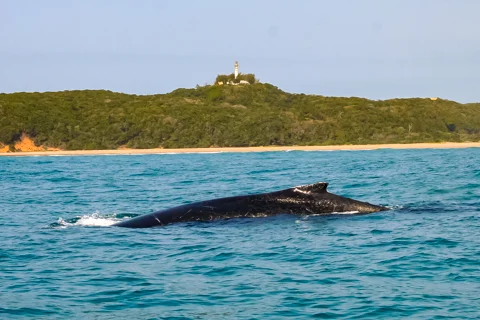
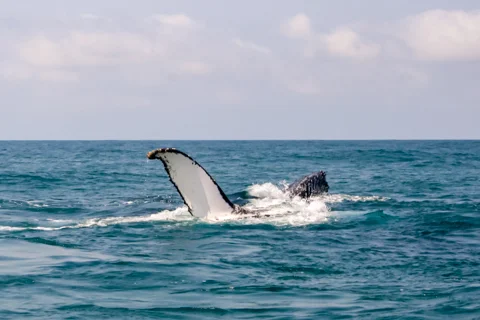
During the months of July through to the end of November, migrating Humpback Whales and the occasional Southern Right Whale frequent the shores of Inhaca to mate, give birth and nurture their offspring before making their long and arduous journey back to the Antarctic to feed.
Up to 30 to 40 Humpback Whales a day have been spotted on occasion around Inhaca Island and there are no words that can describe the humility you feel being in their presence. Humpback whales are an endangered species. It is encouraging to note that the southern hemisphere humpback whale populations continue to recover on year to year basis and are no longer considered endangered, listed as 'Least Concern' globally by the IUCN.
Having migrated south from rich northern waters provisioned with tons of blubber, the Humpbacks do not feed for the duration of their tropical visit. Instead they devote all of their energy to birthing and nursing a new generation of young, or in courting and mating to create the next.
The topside observer is treated to a full array of individual and group surface behaviours including a variety of thrilling breaches, pectoral fin slapping, spy hopping, peduncle throws and lob tailing. It is possible to be able to witness all these behaviours in a day's excursion!
Where Dolphins are family-based and highly social, Whales are anti-social. If you see two 40-foot-long grown whales together, usually one is a female and the other a male. If you see three, it's usually two beaux vying for her attention, and this can be particularly noticeable during the early months of the mating season when their testosterone levels are high and they are eager to find a mate. The presence of a receptive female can lead to competitive rowdy groups as challenging males physically struggle to displace her escort.
When a whale dives, air is compressed in its lungs. Upon reaching the surface, the air is exhaled through the whale's blowholes. The exhaled air expands, causing the temperature to decrease, thereby condensing into water vapour. The blow is quite visible and can reach heights of 20 feet. In concert with the blow is the sound of rushing air that can be heard up to 800 feet away. The blow of a humpback whale is unique to each animal and a great way to distinguish between types of whales.
On average, adult humpback whales take a breath every ten to fifteen minutes, but can remain submerged for as long as forty-five minutes. Calves must rise to the surface every three to five minutes to breathe. The trip can take up to 3 hours and sighting of Whales is not guaranteed. Please look out for Bottlenose and Spinner Dolphins who are frequently spotted around these northern waters of the Island.